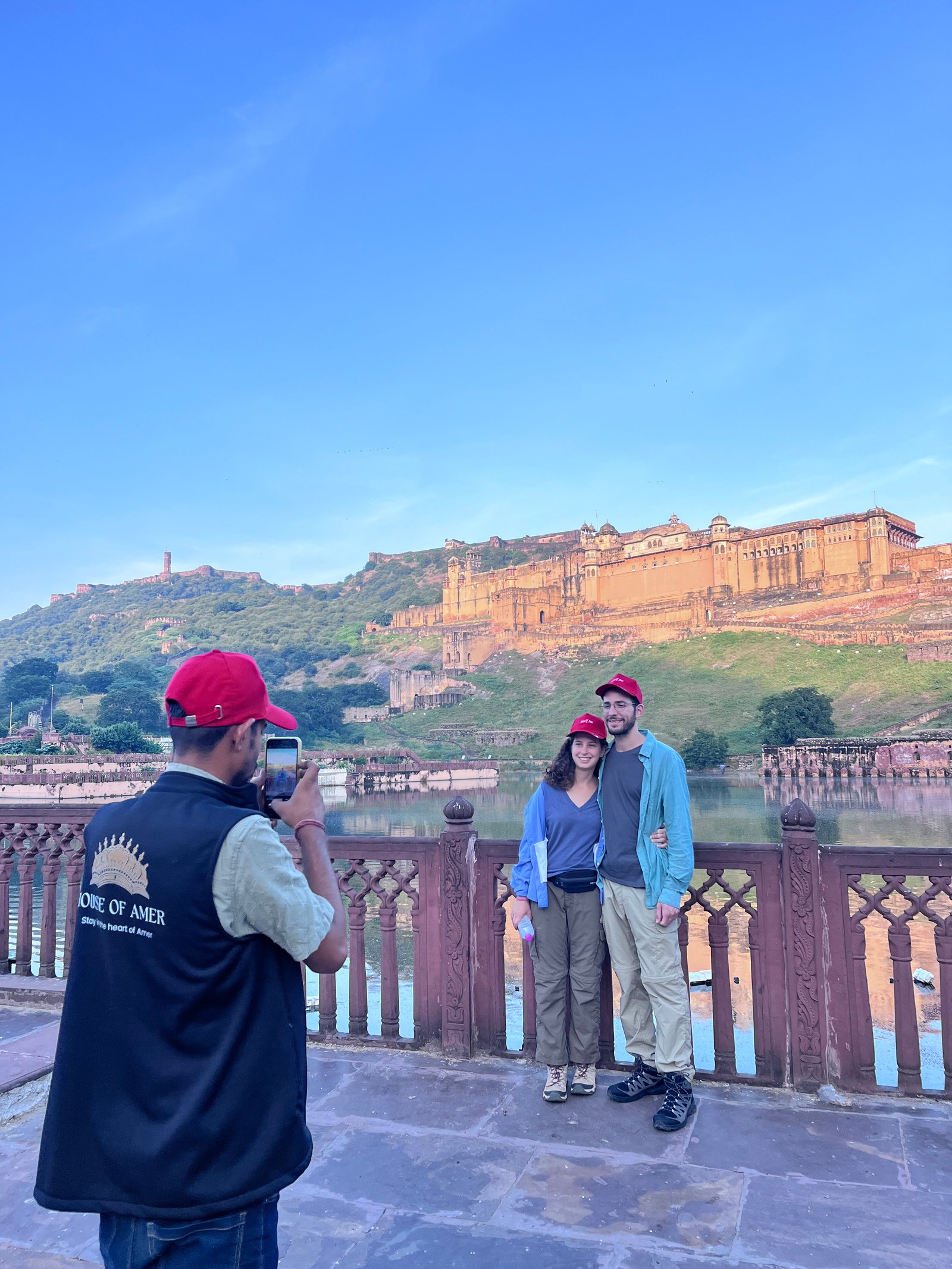
For millions of travellers, a visit to Jaipur is incomplete without seeing this magnificent fort-palace. But Amer Fort is more than an impressive monument to photograph. Its courtyards, palaces, temples, gardens, gateways and defensive walls tell the story of the rulers who made Amer their capital and shaped the history of the region.
Today, Amer Fort is part of the UNESCO World Heritage Site “Hill Forts of Rajasthan,” a group of six forts that together represent the architectural and cultural traditions of the Rajput princely states. UNESCO describes Amber Palace as an important example of the development of a Rajput-Mughal court style, particularly through buildings and gardens added during the 17th century. (UNESCO World Heritage Centre)
At House of Amer, located in the historic heart of Amer, we believe that understanding the story behind the fort makes visiting it even more meaningful.
Where Is Amer Fort?
Amer Fort, also known as Amber Fort or Amber Palace, is located in Amer, approximately 11 kilometres from central Jaipur.
The fort sits in the Aravalli landscape, overlooking Maota Lake and the historic town of Amer below. Rajasthan Tourism describes the complex as a large palace-fort built using sandstone and white marble, with a series of courtyards and important royal, residential and religious spaces. (Rajasthan Tourism)
Its location was not accidental.
Amer developed in a landscape where hills provided natural defensive advantages. The fort’s position, together with the surrounding hills and the connected defensive structures of the region, helped make Amer a significant seat of power.
Amer Was the Capital Before Jaipur
To understand Amer Fort, it is important to understand the relationship between Amer and Jaipur.
Today, Jaipur is the capital of Rajasthan and one of India’s best-known cities. But Jaipur is considerably younger than historic Amer.
Jaipur was founded in 1727 by Sawai Jai Singh II, who moved the capital from Amer to the new planned city because of increasing population and water-related pressures. Rajasthan Tourism identifies Amer as the former stronghold and capital of the Kachwahas before the shift to Jaipur. (Rajasthan Tourism)
This means that when you visit Amer today, you are not simply visiting an attraction outside Jaipur.
You are visiting the landscape of an earlier capital.
That distinction is one of the reasons we believe staying in Amer offers travellers a different perspective on Jaipur’s history.
The Story of Amer Fort
The present palace complex developed over several generations.
Rajasthan Tourism attributes the beginning of the major construction of the palace to Raja Man Singh I in 1592, with subsequent development under later rulers, including Mirza Raja Jai Singh I and other Kachwaha rulers. (Rajasthan Tourism)
The result is not a building created at one particular moment.
It is a layered complex shaped by successive generations of rulers, changing architectural ideas and evolving royal requirements.
This is part of what makes Amer Fort so fascinating.
As you move through its courtyards, halls and palaces, you are effectively moving through different chapters of Amer’s history.
A Blend of Rajput and Mughal Architecture
One of the most distinctive aspects of Amer Fort is its architectural character.
The complex combines elements associated with Rajput traditions and Mughal-influenced design.
UNESCO specifically identifies Amber Palace as representing a key phase in the development of a common Rajput-Mughal court style, particularly in the buildings and gardens added during the 17th century by Mirza Raja Jai Singh I. (UNESCO World Heritage Centre)
The architecture includes imposing gateways, courtyards, decorative details, gardens, mirror work and carefully designed spaces that served different royal functions.
The contrast is particularly striking.
From the outside, the fort appears defensive and imposing.
Inside, the architecture becomes increasingly refined and decorative.
The Four Main Courtyards
Amer Fort is organised around a series of courtyards, each connected to different functions of the palace.
Rajasthan Tourism describes the fort as being divided into four principal sections, each centred around its own courtyard. These areas include spaces associated with public audiences, royal residences, women’s quarters, gardens and temples. (Rajasthan Tourism)
Rather than thinking of Amer Fort as a single palace building, it is better understood as a complete royal complex.
There were spaces for administration.
Spaces for audiences.
Private residential areas.
Religious spaces.
Gardens.
Defensive structures.
And areas designed specifically for royal life.
Jaleb Chowk
One of the first major spaces visitors encounter is Jaleb Chowk, a large courtyard reached through the fort’s principal gateways.
Historically, it served an important public and military function. Rajasthan Tourism notes that returning armies displayed their spoils here for the people. (Rajasthan Tourism)
Standing in the courtyard today, it can be difficult to imagine the activity that once took place here.
Yet this is precisely what makes historic places fascinating.
The stones remain, but the people and sounds have changed.
Sheesh Mahal — The Mirror Palace
Among Amer Fort’s most famous spaces is the Sheesh Mahal, or Mirror Palace.
The use of small pieces of mirror and decorative craftsmanship creates a remarkable visual effect.
It is one of the spaces that demonstrates how the fort was not designed only for defence.
It was also a royal residence designed to impress.
UNESCO notes the use of mirror-work, decorative surfaces, courtyards, gardens and carefully designed architectural details within the palace complex. (UNESCO World Heritage Centre)
The Gardens and Maota Lake
The relationship between the fort and the landscape is another important part of its character.
Maota Lake lies below the palace, creating a striking foreground when viewed from the fort.
The gardens associated with the palace were also carefully planned.
UNESCO documents the development of gardens around Maota Lake, including the geometric Mughal-influenced layouts and the Kesar Kyari garden located on an island within the lake. (UNESCO World Heritage Centre)
This combination of hills, water, gardens and architecture gives Amer Fort much of its visual character.
It isn’t simply a fort placed on a hill.
It is a carefully integrated landscape of defence, royal architecture and gardens.
Amer Fort and Jaigarh Fort
Look towards the hills above Amer and you will see Jaigarh Fort.
The two fortifications are strategically connected, and UNESCO’s documentation describes Amber Fort as being situated below Jaigarh, with the two linked through their defensive system. (UNESCO World Heritage Centre)
Rajasthan Tourism also notes underground passages connecting Amer Fort and Jaigarh Fort, with a restored section open to visitors. (Rajasthan Tourism)
This relationship helps explain the wider defensive landscape of historic Amer.
The forts, hills and surrounding settlements were not isolated attractions.
They formed part of a larger strategic environment.
Why Amer Fort Became a UNESCO World Heritage Site
Amer Fort is included within the UNESCO World Heritage property known as the Hill Forts of Rajasthan.
The property includes six forts:
* Chittorgarh
* Kumbhalgarh
* Ranthambore
* Gagron
* Amber
* Jaisalmer
UNESCO inscribed the Hill Forts of Rajasthan on the World Heritage List under criteria recognising the exchange of Rajput architectural ideas and the forts as expressions of Rajput political, cultural and architectural traditions. (UNESCO World Heritage Centre)
For Amer specifically, UNESCO highlights its importance in the development of the Rajput-Mughal court style.
So when visitors walk through Amer Fort, they are experiencing a monument that forms part of a much larger story about the architecture, politics and culture of historic Rajasthan.
Don’t Stop at Amer Fort
This is something we often tell our guests at House of Amer.
Amer Fort should be the beginning of your exploration of Amer, not necessarily the end of it.
The historic town surrounding the fort has its own stories.
There are temples, old havelis, stepwells, traditional streets, local homes and historic sites that can be explored on foot.
Places such as Panna Meena Kund, Jagat Shiromani Temple, Keshav Rai Ji Temple and Ambikeshwar Mahadev Temple provide a glimpse into the wider cultural landscape of Amer.
This is why we created our Heritage & Cultural Walk at House of Amer.
Instead of simply visiting one monument, guests can spend time understanding the historic neighbourhood around it and discovering some of the places that can be overlooked during a conventional Jaipur sightseeing itinerary.
Why Staying in Amer Changes the Experience
There is a difference between visiting Amer for a few hours and actually staying in Amer.
When you stay nearby, you can experience the area at different times of the day.
You can explore early in the morning.
Walk through the historic streets.
Return to your accommodation for a break.
Visit the fort again in a different light.
Discover local temples and havelis.
Enjoy a traditional meal.
And simply observe the rhythm of the old town.
This was one of the reasons Rajyavardhan Singh, founder of House of Amer, chose to restore a historic family home in Amer and create a heritage stay here.
The idea was simple:
If travellers come to Amer to experience history, why not give them the opportunity to actually stay in the middle of it?
A Different Way to Experience Amer Fort
At House of Amer, our approach is not to tell guests simply to “visit Amer Fort.”
We encourage them to understand the destination around it.
Walk through Amer.
Learn about its temples.
Discover its architecture.
Taste traditional Rajasthani food.
Explore the hills.
Experience the quieter side of the area.
And then return to a historic family haveli at the end of the day.
Because the story of Amer is much larger than one fort.
Visiting Amer Fort With More Time
If you are planning your Jaipur itinerary, consider giving Amer more than a few hours.
A thoughtful Amer experience could include:
Morning:
Begin with an early visit to Amer Fort and explore its courtyards, palaces and architectural details.
Late morning:
Explore Panna Meena Kund and the historic surroundings of Amer.
Afternoon:
Take a break and enjoy a traditional meal or a local cultural experience.
Later:
Explore Amer’s temples, havelis and old streets through a heritage walk.
Evening:
Return to your heritage stay and enjoy rooftop dining while taking in the surrounding landscape.
This slower approach allows Amer to become more than another item on a Jaipur checklist.
Amer Fort Is a Gateway to Rajasthan’s History
Amer Fort represents much more than royal architecture.
It represents a period when Amer was a major centre of power, when the Kachwaha rulers shaped the region, and when Rajput and Mughal architectural traditions interacted to create a distinctive courtly style.
Its walls, courtyards, gardens and palaces preserve parts of that story.
But the history does not stop at the fort’s gates.
It continues through the streets of Amer.
Through its temples.
Through its old homes.
Through its food.
And through the people who continue to live in this historic town.
That is why, at House of Amer, we believe the best way to understand Amer is not simply to see its fort.
It is to experience Amer itself.
Stay in History. Live the Soul of Amer.
About House of Amer
House of Amer is a heritage boutique stay in the historic heart of Amer, Jaipur. Set within a 200-year-old family haveli, the property offers travellers an opportunity to experience Amer beyond conventional sightseeing through heritage walks, cultural experiences, traditional cooking, rooftop dining, yoga, hiking and other curated activities.
Founded by Rajyavardhan Singh, House of Amer was created with the idea of preserving the character of a historic family home while helping travellers experience the living heritage and culture of Amer.
Rajyavardhan Singh
Founder and Owner of House of Amer
+91 8619700201