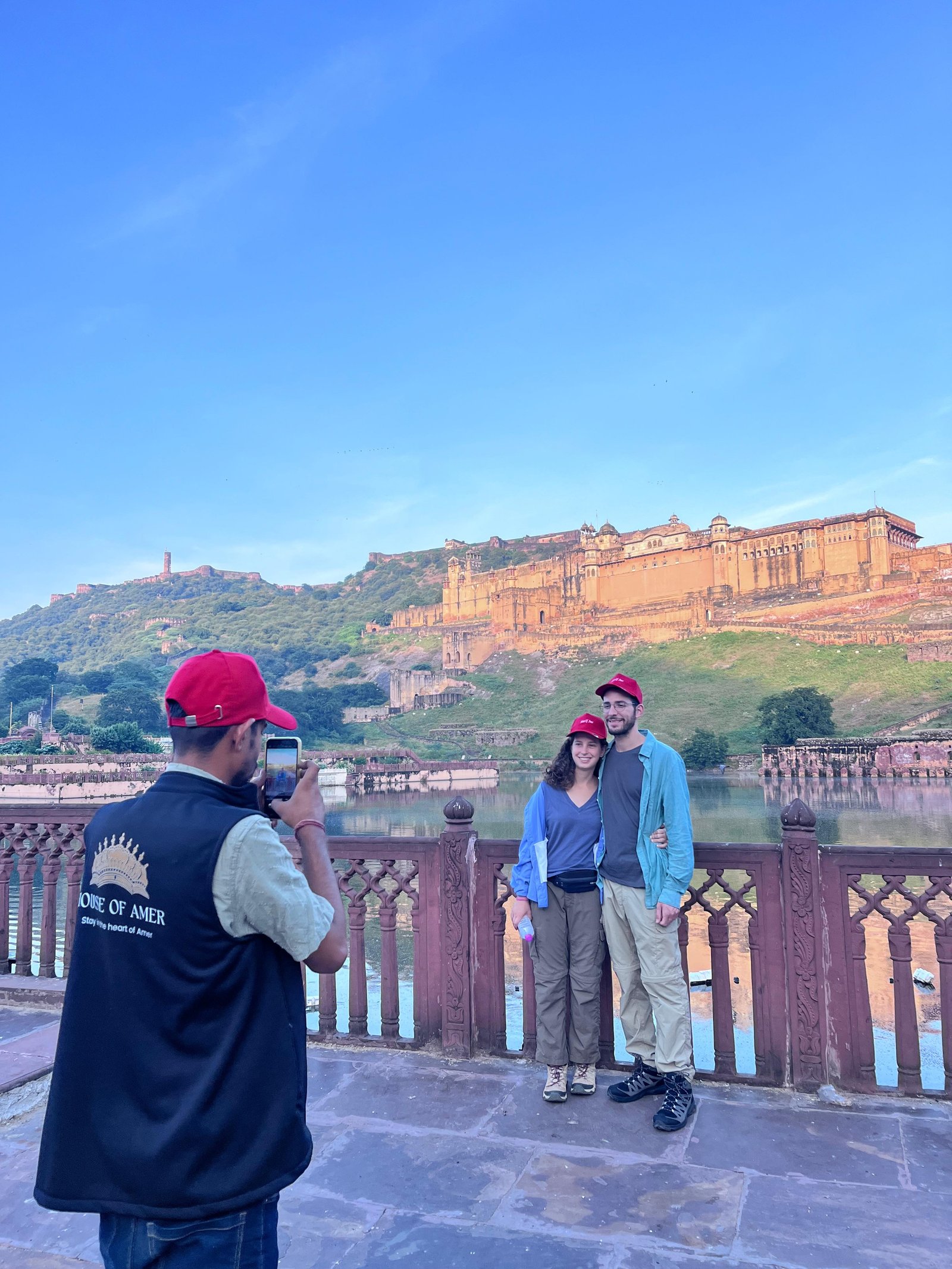
Perched dramatically against the Aravalli Hills, Amer Fort is one of the most remarkable heritage monuments in Rajasthan.
For many travellers visiting Jaipur, a visit to Amer Fort is one of the highlights of their journey. But Amer Fort is more than a beautiful palace with grand courtyards and intricate architecture. It is a place where centuries of Rajput history, royal traditions, architecture and stories come together.
And perhaps the best way to experience it is not simply to arrive, take a few photographs and leave.
It is to slow down, understand its history and explore the historic town of Amer around it.
At House of Amer, we are fortunate to be located in the historic heart of Amer, just a short walk from the fort. This gives our guests the opportunity to experience Amer at a different pace — early in the morning, when the streets are quieter, or later in the day when the fort and surrounding hills take on a completely different character.
A Brief History of Amer Fort
Amer, also known as Amber, was the historic capital of the Kachhwaha Rajputs before Jaipur was established in 1727.
The present Amer Fort developed over several generations. Raja Man Singh I began the major construction of the present palace complex in 1592, and later rulers continued to expand and embellish it.
Over time, the fort became an important centre of royal life and administration.
Its architecture reflects the interaction between Rajput and Mughal artistic traditions, visible in its courtyards, gateways, palaces, gardens, decorative stonework and intricate mirror work.
Today, Amer Fort forms part of the Hill Forts of Rajasthan, which are recognised as a UNESCO World Heritage Site.
But the story of Amer extends far beyond the walls of the fort.
What Makes Amer Fort Special?
One of the most fascinating aspects of Amer Fort is the way its architecture unfolds as you move through the complex.
Rather than being a single palace building, the fort is a collection of courtyards, halls, gateways, temples and royal spaces that developed over time.
Every section tells a different part of the story.
Suraj Pol — The Main Entrance
Suraj Pol, or the Sun Gate, is one of the principal entrances to the palace complex.
As you enter, the scale of the fort immediately begins to reveal itself.
The massive walls, traditional architecture and surrounding hills provide a glimpse into the strategic and royal importance of Amer.
Jaleb Chowk
Jaleb Chowk is one of the largest courtyards within Amer Fort.
Historically, courtyards such as this were important spaces within the royal complex and were connected to the movement of soldiers, visitors and members of the royal household.
Today, it provides visitors with one of the first major impressions of the scale of the palace.
Diwan-i-Aam
The Diwan-i-Aam, or Hall of Public Audience, was associated with royal audiences and public affairs.
Its elegant columns and open character demonstrate how architecture was used not only for beauty but also for the practical functioning of royal life.
Ganesh Pol
One of the most recognisable architectural features of Amer Fort is Ganesh Pol.
The gateway is richly decorated and leads towards the private palace areas.
Its colourful ornamentation and detailed craftsmanship make it one of the most photographed parts of the fort.
Sheesh Mahal
The Sheesh Mahal, or Mirror Palace, is among the most celebrated spaces within Amer Fort.
The use of small pieces of reflective glass and intricate decorative work creates an extraordinary visual effect.
The craftsmanship is particularly beautiful when viewed closely, where individual details become visible.
This is one of the places where taking a moment to look beyond the overall grandeur reveals just how much skill went into the palace’s decoration.
The Relationship Between Amer Fort and the Aravalli Hills
Amer Fort was not built in isolation.
Its location within the Aravalli landscape was an important part of its character and defensive setting.
From different points around Amer, visitors can see the surrounding hills, old fortifications and historic landscape.
The nearby Jaigarh Fort rises above Amer, while Maota Lake lies below the palace complex.
Together, these elements form a remarkable historic landscape.
This is one reason why exploring Amer is different from simply visiting an individual monument.
The fort, hills, lake, temples, old streets and surrounding architecture are all part of the same historic environment.
What to See Around Amer Fort
If you have time, don’t leave immediately after visiting the fort.
Amer has much more to discover.
Panna Meena ka Kund
Located close to Amer Fort, Panna Meena ka Kund is a historic stepwell known for its symmetrical geometric design.
The structure provides a fascinating glimpse into traditional water architecture in Rajasthan.
Jagat Shiromani Temple
The Jagat Shiromani Temple is another important heritage site in Amer.
Its detailed architecture and peaceful atmosphere make it worth including in a walking exploration of the town.
Sagar Lake
Sagar Lake sits within the historic landscape of Amer and offers a quieter experience away from the main tourist areas.
The surrounding Aravalli landscape can be particularly beautiful during the early morning.
Jaigarh Fort
Located above Amer, Jaigarh Fort is closely connected to the history and defence of the region.
Its elevated position offers extensive views across the surrounding landscape.
If you have additional time in Amer, combining Amer Fort and Jaigarh Fort can provide a deeper understanding of the area’s historic fortifications.
When Is the Best Time to Visit Amer Fort?
For many travellers, the morning is one of the most enjoyable times to explore Amer.
The light is softer, temperatures are generally more comfortable during cooler months, and the historic surroundings can feel quieter than during the busiest parts of the day.
Early morning also allows you to explore the surrounding streets of Amer before continuing with the rest of your Jaipur itinerary.
The best season depends on what you want from your visit.
October to March
The cooler months are generally popular for exploring Jaipur’s outdoor heritage sites.
April to June
Summer in Jaipur can be very hot, particularly during the middle of the day. Early morning visits can therefore be more comfortable.
July to September
The monsoon can bring a different character to the Aravalli landscape, with occasional greenery and changing skies. Weather conditions can vary, so travellers should plan accordingly.
How Much Time Should You Spend at Amer Fort?
If you only want to see the major sections of the fort, you can complete a visit in a few hours.
However, if you want to understand the architecture, take photographs, explore nearby heritage sites and walk through the old town of Amer, it is worth giving the area considerably more time.
We recommend thinking of Amer as a destination rather than just a monument.
Spend the morning exploring the fort.
Walk through the historic neighbourhoods.
Visit nearby temples and the stepwell.
Return to your hotel for some rest.
Then watch the Aravallis change colour as the evening approaches.
That is when Amer begins to feel less like a tourist attraction and more like a living historic town.
Why Stay Near Amer Fort?
Many visitors to Jaipur stay in the central city and travel to Amer for a few hours.
That works well if your itinerary is focused primarily on Jaipur’s central monuments.
But staying in Amer offers a different experience.
Instead of arriving in Amer for a short visit, you can wake up here.
You can walk to Amer Fort.
You can explore the old streets when they are quieter.
You can discover nearby temples and heritage sites without rushing.
And you can return to your accommodation after a day of sightseeing and experience the peaceful side of the Aravalli landscape.
Stay at House of Amer
Located in the historic heart of Amer, House of Amer is a 200-year-old family haveli that has been opened to travellers from around the world.
The property combines heritage architecture with the comfort of a boutique stay, allowing guests to experience Amer as more than just a sightseeing stop. (House of Amer)
Amer Fort, Panna Meena Kund and Sagar Lake are all within walking distance of the property, while other major Jaipur attractions can be reached by road. (House of Amer)
For guests who want to explore beyond the usual tourist itinerary, House of Amer also offers experiences including a heritage and cultural walk through Amer, rooftop yoga, Rajasthani cultural evenings, cooking experiences and other local activities. (House of Amer)
The rooftop is also a beautiful place to slow down after exploring the fort, with views across the historic landscape and Aravalli Hills.
Experience Amer Beyond the Fort
The most memorable part of visiting Amer may not be a single room inside the palace.
It may be the moment you walk through an old street in the morning.
A temple bell in the distance.
The Aravalli Hills rising behind the historic buildings.
The first light touching the walls of Amer Fort.
A conversation with a local resident.
A traditional meal at the end of the day.
These are the moments that turn a visit into an experience.
Amer Fort is undoubtedly one of Rajasthan’s great monuments.
But the real beauty of Amer lies in discovering what exists around it.
Plan Your Amer Experience
If you are visiting Jaipur, make time to experience Amer slowly.
Explore Amer Fort.
Discover Panna Meena Kund.
Visit the historic temples.
Walk through the old neighbourhoods.
Take in the Aravallis.
And if possible, spend a night in Amer itself.
Because Amer is not simply somewhere you visit from Jaipur.
It is a place where you can stay in history, walk through living heritage and experience another side of Rajasthan.
Stay in History. Live the Soul of Amer.
Begin your Amer experience from House of Amer, a heritage haveli in the heart of historic Amer.
House of Amer
Near Jagat Shiromani Temple, Devisinghpura, Amer, Jaipur, Rajasthan
Explore your stay and experiences at House of Amer.
Rajyavardhan Singh
Founder and Owner House of Amer
+91 8619700201