Beyond Amer Fort: Discover the Hidden Heritage of Amer
When most travellers think of Amer, one magnificent monument immediately comes to mind: Amer Fort.
Its imposing walls, grand gateways, courtyards and intricate palace architecture have made it one of Rajasthan’s most recognisable landmarks.
But Amer is much more than its fort.
Before Jaipur became the capital of the Kachhwaha kingdom in 1727, Amer was an important centre of royal life, religion, architecture and trade. The heritage of this historic town can still be discovered in its temples, stepwells, old havelis, narrow streets and surrounding landscape.
For travellers willing to look beyond the main attraction, Amer offers something different — a chance to experience a historic Rajasthani town rather than simply visiting a monument.
And this is where the real character of Amer begins to reveal itself.
Amer: More Than a Fort
Amer developed over centuries around its royal centre.
The fort dominates the landscape, but the town surrounding it was an equally important part of everyday life.
Merchants, craftsmen, priests, residents and royal households all contributed to the development of Amer.
Today, traces of that history remain throughout the town.
Walk away from the main entrance of Amer Fort and you will find historic lanes, traditional buildings, temples and houses that often receive far fewer visitors.
There is no grand entrance announcing these places.
You simply discover them as you walk.
Explore the Historic Streets of Amer
One of the best ways to experience Amer is on foot.
The old streets around the fort retain a traditional character that can be very different from the busy tourist areas of central Jaipur.
Look closely at the buildings and you may notice traditional architectural details, carved entrances, old balconies and colourful facades.
Some buildings are still homes.
Others have been adapted over the years.
Together, they form part of the living heritage of Amer.
A heritage walk through these streets allows visitors to understand that Amer is not simply an archaeological site.
It is a historic settlement where everyday life continues alongside centuries-old architecture.
Jagat Shiromani Temple
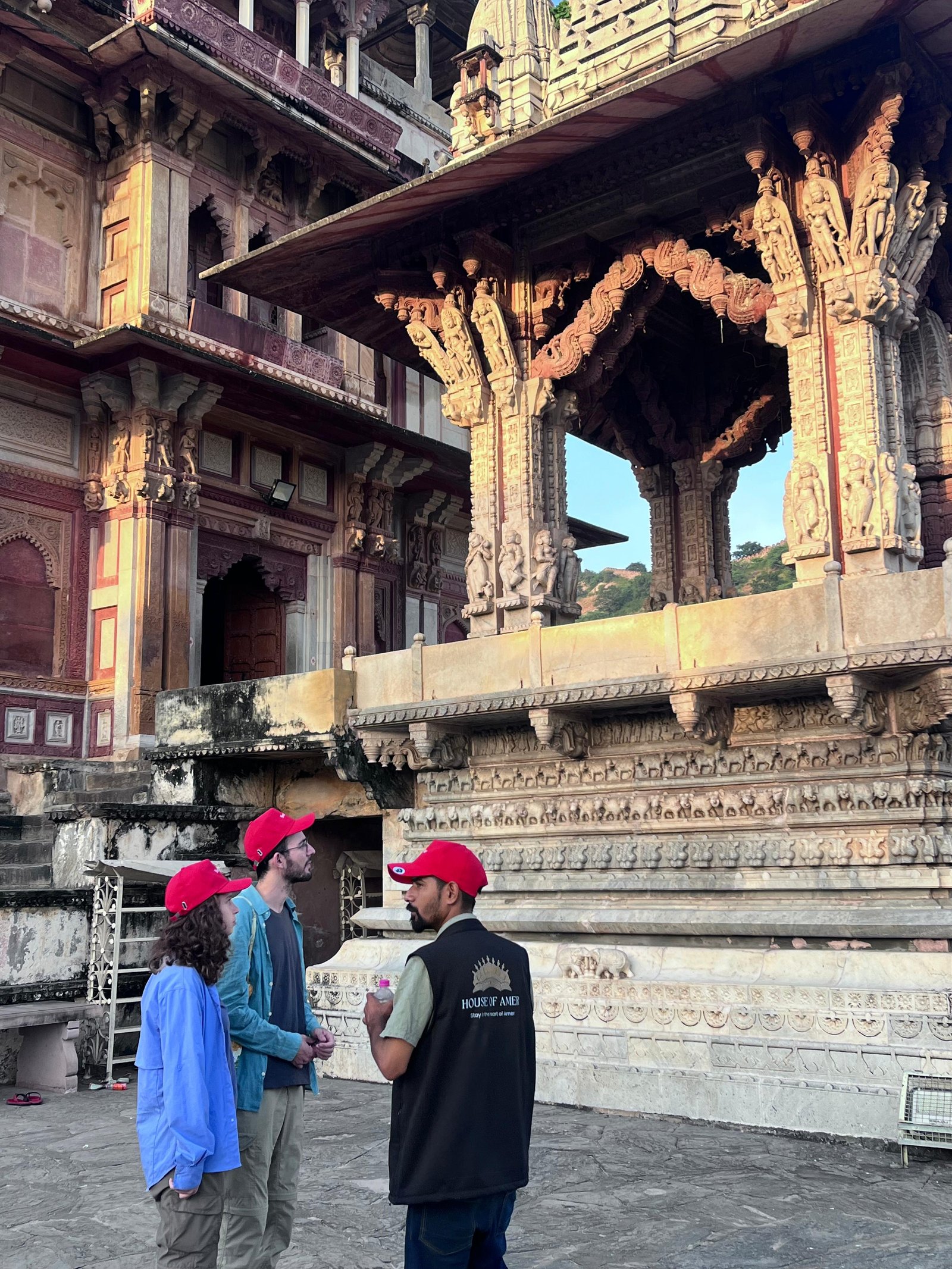
Among Amer’s most beautiful historic temples is the Jagat Shiromani Temple.
The temple is known for its detailed architecture and ornate stonework.
Located within the historic town, it provides a quieter experience compared with the large crowds that can gather around Amer Fort.
The temple is traditionally associated with Meera Bai and Lord Krishna, and its architecture reflects the artistic traditions of Rajasthan.
For travellers interested in heritage and architecture, it is an important stop while exploring Amer.
Take your time here.
Rather than simply photographing the exterior, look at the craftsmanship, pillars, carvings and details that reveal the skill of the artisans who created it.
Panna Meena ka Kund: Amer’s Historic Stepwell
Rajasthan’s relationship with water has shaped its architecture for centuries.
In a landscape where water was precious, stepwells provided both practical and social spaces.
Panna Meena ka Kund, located near Amer Fort, is one of the best-known examples in the area.
Its geometric arrangement of steps creates a striking pattern when viewed from above.
But the importance of stepwells goes beyond their appearance.
They were designed to provide access to water at different levels depending on the season and water level.
They also became gathering spaces within communities.
Standing at Panna Meena ka Kund today offers a glimpse into the ingenuity of traditional water architecture in Rajasthan.
Ambikeshwar Mahadev Temple
Amer is also home to historic temples that continue to play a role in the spiritual life of the local community.
The Ambikeshwar Mahadev Temple is dedicated to Lord Shiva and is among the important religious sites associated with the old town of Amer.
Places like this offer a different perspective on the area.
While Amer Fort tells the story of royalty and political power, its temples reveal another side of Amer — its continuing religious and community traditions.
When visiting temples, travellers should be respectful of local customs and dress appropriately.
Keshav Rai Ji Temple
Another lesser-known heritage site in Amer is the Keshav Rai Ji Temple.
Like many historic temples in Rajasthan, its importance extends beyond architecture.
These temples form part of the cultural landscape of the old town and provide visitors with an opportunity to experience a quieter side of Amer.
Exploring such places with a local guide can make the experience considerably more meaningful, particularly when learning about local traditions and the stories connected with the temples.
Discover the Old Havelis
The heritage of Amer isn’t limited to monuments.
Some of the most interesting architecture can be found in its old residential buildings.
Traditional havelis were designed around courtyards and often featured carved entrances, balconies, decorative facades and carefully planned spaces that helped regulate light, ventilation and privacy.
Some have survived remarkably well.
Others have changed with time.
This mixture of old and new is part of what makes walking through Amer interesting.
The town isn’t frozen in the past.
It is a living neighbourhood where historic architecture exists alongside modern everyday life.
Sagar Lake and the Aravalli Landscape
Beyond the buildings, Amer’s natural landscape is an important part of its identity.
The surrounding Aravalli Hills create a dramatic backdrop to the historic town.
Sagar Lake, situated within the Amer landscape, adds another dimension to the area.
Early morning can be a particularly peaceful time to explore the surroundings.
The combination of hills, water, historic structures and changing light makes the landscape feel very different from the busy streets of central Jaipur.
For travellers interested in photography, architecture or simply quieter experiences, this part of Amer is worth exploring.
Look Up: Amer’s Traditional Architecture
One of the pleasures of exploring Amer on foot is noticing details that can easily be missed from a vehicle.
Look at the doors.
Look at the windows.
Notice the balconies.
Observe how buildings are positioned along narrow streets.
Look for traditional decorative elements.
Rajasthan’s architectural heritage is often found in these small details rather than only in grand palaces.
A carved doorway on an ordinary-looking house can sometimes tell you as much about traditional craftsmanship as a major monument.
Experience Amer Like a Local
The best way to discover the hidden side of Amer is to slow down.
Instead of trying to see everything in a few hours, allow yourself time to wander.
Start with Amer Fort in the morning.
Continue towards the historic streets.
Visit one of the old temples.
Explore Panna Meena ka Kund.
Take a break.
Walk through the neighbourhoods.
Stop for a cup of chai.
Talk to local residents where appropriate.
And simply observe.
This slower approach allows you to notice things that are easy to miss when travelling from one major attraction to another.
Why a Heritage Walk Makes a Difference
A local guide can transform a walk through Amer.
Without context, an old building may simply look like an old building.
With the right story, you begin to understand why it was built, who lived there, how the neighbourhood developed and how it connects with the larger history of Amer.
At House of Amer, our heritage and cultural experiences are designed to help guests discover this side of the town.
Rather than focusing only on the famous monuments, the experience introduces travellers to the streets, stories, architecture and cultural traditions that make Amer unique.
Stay in the Heart of Historic Amer
One of the biggest advantages of staying in Amer is having the opportunity to explore it before and after the busiest sightseeing hours.
House of Amer is a heritage boutique property located in the historic heart of Amer.
The property itself is a restored family haveli, giving guests the opportunity to stay within the historic environment rather than simply visiting it for a few hours.
From the property, guests can explore nearby heritage attractions, walk through the old streets and experience the atmosphere of Amer at a slower pace.
The rooftop also provides a place to relax while taking in views of the surrounding historic landscape and Aravalli Hills.
Amer After the Tourists Leave
There is another side of Amer that becomes visible when the day’s main sightseeing crowds begin to disappear.
The streets become quieter.
The light changes across the hills.
The sounds of the town become more noticeable.
The fort takes on a different appearance as the sun moves across the sky.
This is one of the reasons staying overnight in Amer can be such a different experience from simply taking a day trip from Jaipur.
You have time.
And time allows you to see more.
Discover the Living Heritage of Amer
Amer’s greatest treasure may not be limited to its most famous monument.
It is the combination of everything around it.
The fort.
The temples.
The stepwells.
The old havelis.
The narrow streets.
The Aravalli Hills.
The local communities.
The traditions that continue today.
Together, they create the cultural landscape of historic Amer.
So when you visit Amer, don’t simply tick Amer Fort off your Jaipur itinerary.
Take a little more time.
Walk beyond the fort.
Look beyond the obvious.
Discover the temples, stepwells, old houses and streets.
Listen to the stories.
And experience Amer not just as a monument, but as a living piece of Rajasthan.
Experience the Hidden Heritage of Amer with House of Amer
Located in the heart of historic Amer, House of Amer offers travellers an opportunity to experience the town beyond its famous monuments.
Stay in a heritage haveli, explore the old neighbourhoods, discover local culture and experience Amer at a slower, more authentic pace.
Come for Amer Fort. Stay for Amer itself.